Why a 3-Month Safety Net is Life-Changing
Most financial advice tells you to have "3 to 6 months of living expenses" in the bank. But for anyone facing high rent, grocery inflation, and stubborn debts, saving thousands of dollars feels daunting.
The secret to reaching a fully funded safety net without burning out is understanding that your emergency fund does not need to replace your current lifestyle—it only needs to cover your survival baseline.
If you were suddenly laid off or faced an extended medical issue, you wouldn't be dining out three nights a week or ordering subscription boxes. You would switch to survival mode. When you calculate your emergency fund based on essential expenses, your savings target becomes significantly smaller and faster to achieve.
Use our free Interactive Emergency Fund Calculator to discover your exact monthly survival burn rate and completion timeline in seconds.
Step 1: Calculate Your True Monthly Survival Burn Rate
To determine your target, strip away all discretionary spending. Focus strictly on these non-negotiable categories:
- Housing: Rent or mortgage payment, property taxes, and basic homeowner/renter insurance.
- Utilities: Electricity, water, natural gas, trash, and minimum home internet.
- Groceries & Toiletries: Whole ingredients and household hygiene (exclude restaurant delivery and alcohol).
- Transportation: Car payment, insurance, fuel, and transit passes necessary for work.
- Debt Minimums: Minimum required monthly payments on student loans, auto notes, and credit cards.
- Healthcare: Prescriptions, vital medications, and essential insurance premiums.
Example Baseline:
- Housing: $1,400
- Utilities: $220
- Groceries: $400
- Transportation: $300
- Debt Minimums: $180
- Healthcare: $100
- Total Survival Burn Rate: $2,600 / month
For this person, a 3-month emergency fund is $7,800 (not the $15,000+ that generic budgeting rules estimate based on gross income).
Step 2: Separate Your Stash from Your Everyday Checking
The single biggest reason people fail to build an emergency fund is keeping the money in their daily checking account or primary bank.
When your emergency fund sits in the same mobile banking app as your debit card:
- Your brain views that balance as available money.
- You are more likely to justify a $200 weekend trip or shopping splurge.
- Your money sits earning 0.01% interest instead of working for you.
Open a dedicated High-Yield Savings Account (HYSA) at an external FDIC-insured online institution. High-yield savings accounts currently offer 4.5% to 5.0% APY. A $7,800 emergency fund stored in a 5.0% HYSA earns approximately $390 a year in completely free, passive compound interest.
Furthermore, moving money from an external bank takes 1 to 2 business days. That friction is a blessing—it stops impulsive withdrawals in their tracks.
Step 3: Implement Payday Automation (Reverse Budgeting)
Do not make the mistake of spending throughout the month and promising to save "whatever is left over." By day 28, there is almost never anything left.
Instead, practice reverse budgeting:
- Choose a fixed, realistic savings target per paycheck (e.g., $250 bi-weekly or $500 monthly).
- Set up an automatic recurring bank transfer scheduled for the exact morning your paycheck clears.
- Live comfortably on the remainder without feeling guilty.
If you save $250 every two weeks, you deposit $6,500 over 12 months. With compound interest, you will hit your 3-month goal before the year is out.
Step 4: Accelerated Injections (The Fast-Track Blueprint)
Want to cut your timeline in half? Use temporary sprint strategies to inject lump sums directly into your emergency stash:
- The 48-Hour Household Declutter: Walk through every room with a laundry basket. List unused electronics, designer coats, power tools, and musical instruments on Facebook Marketplace. Most households easily uncover $500 to $1,500 in dormant goods.
- Tax Refunds & Work Bonuses: Pledge 100% of surprise windfalls or tax returns directly to your emergency fund until milestone 3 is met.
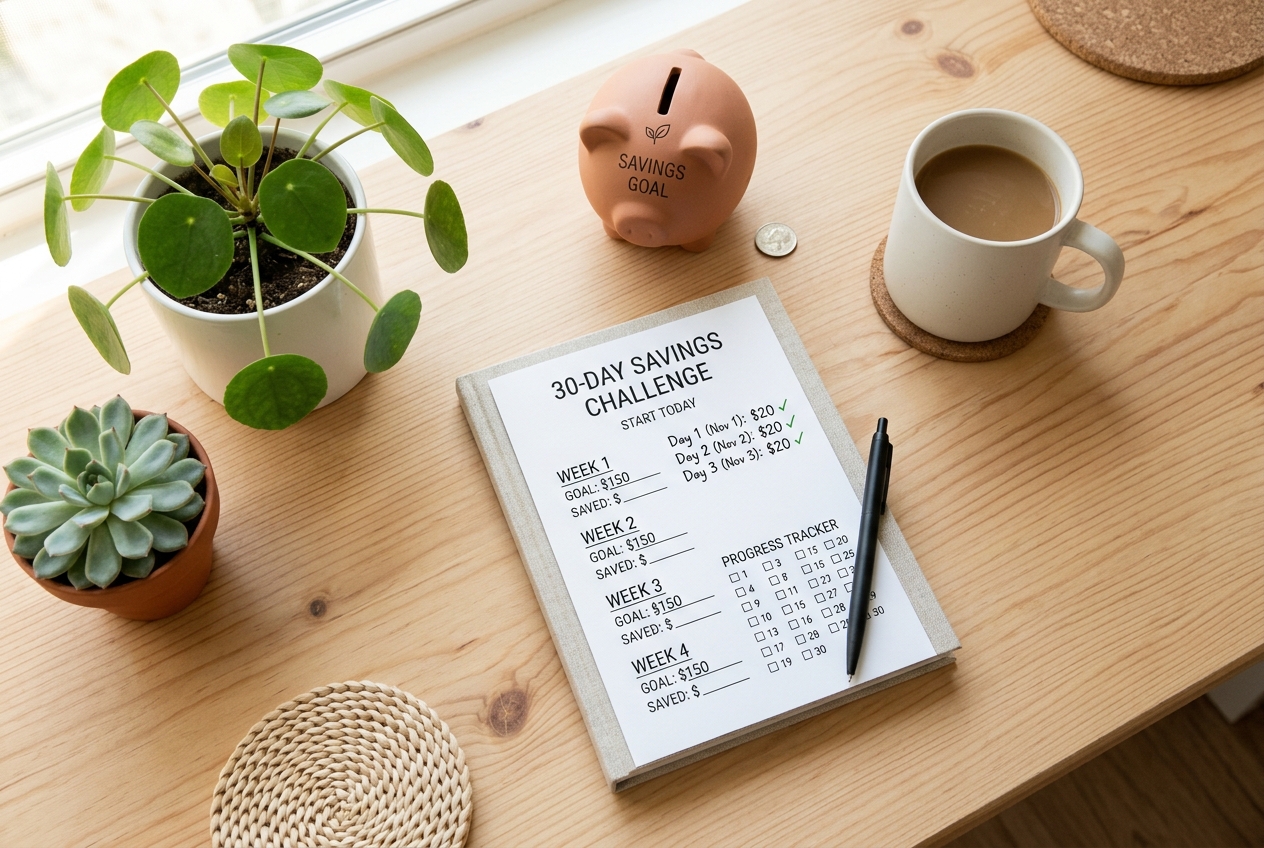
- Temporary "No-Spend" Sprint: Run a 30-day challenge where you cook every meal from home and freeze unnecessary subscriptions. Check out our 30-Day No Spend Challenge Guide and Interactive Challenge Tool.
Download Your Free Emergency Fund Roadmap
To stay motivated and watch your progress unfold, download our free Emergency Fund Milestone Tracker & Deposit Log. It features visual progress rings for your $500 starter stash, 1-month buffer, and 3-month security fortress.